Webinar: LEED v5 Reality Check: Cost, Friction, and Early Wins - Ryan Baumgart, P.E., June 25, 2026

[Editor’s note: The webinar description is posted here first. After the webinar date, scroll down for notes and a link to recording.]

USGBC recently pushed the mandatory LEED v5 registration date to July 1, 2027 — giving project teams one more year to prepare. BranchPattern is already in it, helping BD+C projects transition from LEED v4 to v5. In this webinar, they share what they’ve learned.

This session draws from BranchPattern’s recent case studies with industrial clients navigating the transition from LEED v4 to v5. Rather than theory, the focus is on where teams are experiencing the most friction and what it takes to move projects forward.
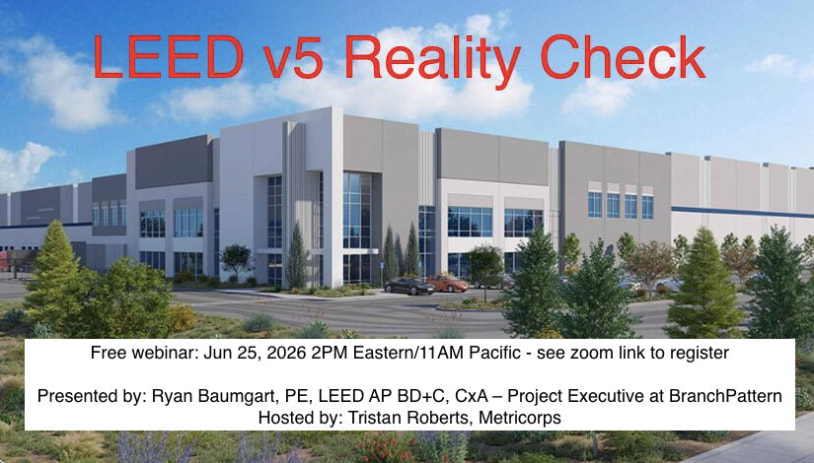
The presentation will focus on a three-building comparison (two in California and one in Illinois), then dive deeper into the implementation details for the project that was ultimately selected. All three are speculative industrial buildings, likely intended for distribution-type uses.

We’ll cover:

→ Electrification and Energy Efficiency Challenges: How the shift toward decarbonization is impacting HVAC system selection and overall project design.

→ Cost Impacts from v4 to v5: Estimated cost premiums tied to the minimum viable path to certification and regional cost variability.

→ Low-Hanging Fruit: Credits and strategies emerging as more achievable wins under LEED v5.

***This meeting is hosted by Tristan Roberts of Metricorps, an independent community for sustainability practitioners navigating LEED v5 and beyond.

***Presenter Ryan Baumgart, PE, LEED AP BD+C, CxA, WELL AP, is a Project Executive at BranchPattern with a mechanical engineering background and hands-on experience across commissioning, building certifications, and energy performance — including projects ranging from high-altitude envelope testing on Pikes Peak to Silicon Valley office fit-outs.

Register: Meeting Registration - Zoom
THANK YOU Ryan Baumgart, P.E. for a great webinar with 80+ attendees for the hour.

Ryan walked us through a three-building case study comparing speculative industrial projects in California and Illinois — cost premiums, electrification tradeoffs, and where the early wins are under v5.

Here’s the presentation:

Great session and turnout!

Looking forward to more v5 webinars offered through Metricorps by the community of LEED experts.

Reviewing the webinar chat, here are a few notes worth saving w/ links:

  • Dave Hubka shared a v5 Envelope Commissioning slide deck on Metricorps mid-session — Ralph Bicknese called it “an awesome resource.” Big shout out to Dave.

  • Jonathan Weiss noted the v5 prerequisite language (see EQp2: Fundamental Air Quality) requires filtration for systems supplying “outdoor air and/or recirculated air,” and he asked whether the reintroduction of “recirculated” was an intentional change from how past LEED versions handled this. Dave, Samuel Calhoun, and Umesh Atre worked through it together, landing on an important nuance: per the Feb 2026 v5 Reference Guide, MERV 13 filtration isn’t required for systems serving warehouses or similar spaces covered under the ASHRAE exemption for outdoor air treatment.

  • Ara Nenninger mentioned synthesizing all 24 currently available BD+C calculators into a single tool to help make sense of them — multiple people reacted immediately wanting access. Ara will be sharing a demo soon – look for it in the forum.

  • Cassidy Green offered this encouragement: “Let’s use this extra year to hype each other up to be excited about v5 and encourage our clients to be excited about it.”

  • Laura Charlier flagged that some LEED reviewers appear to be using AI, with mixed and occasionally incorrect results — worth watching. Dave noted GBCI has told him directly they are not using AI in reviews. My question: is this a clear policy for GBCI contractors? Samuel Calhoun reminded us, as a former reviewer himself, that weird review comments are nothing new — AI or not.

  • Benjamin Boudler joined us from Brazil and said he expects LEED v5’s reporting requirements will push clients there to commit to LEED earlier in the project process, rather than treating it as an afterthought, even as his team continues prioritizing v4 where they can.

To everyone who joined and shared – thank you! That was awesome.